Educational awareness resource only — we are not an email provider, a bank, or a support service, and we never contact you about your accounts or ask for passwords.
SafeMailer Email & banking scam awareness
Educational resource · updated September 2026

Learn how email accounts and bank logins actually get stolen.

SafeMailer is a free awareness library. We reconstruct real-world email scams and fake banking login pages, label what gives them away, and explain the habits that make them fail — nothing to buy, nobody to call.

No sign-in · no personal data collected · no support service

This week's case study

“Approve the sign-in on your phone” — push-approval fatigue

Attackers who already hold a password trigger dozens of sign-in prompts overnight, then phone the victim posing as support, asking them to accept “the verification we just sent”.

{{ p.text }}
Read the breakdown →

Four things worth understanding

Each topic is a short, self-contained explainer — how the attack works, what it looks like, and why the countermeasure works.

Tracking log · September 2026

Latest tactics used to hack email accounts

Full scam library →
{{ t.risk }} {{ t.seen }}

{{ t.title }}

{{ t.body }}

Why it fails: {{ t.defence }}

What SafeMailer is — and isn't

Read this before you trust anything on the internet that claims to help with your accounts, including us.

About & editorial policy →
{{ d.text }}
{{ d.text }}

From the awareness blog

All articles →
Email scam awareness · updated September 2026

The latest ways email accounts get hacked

Passwords are rarely guessed any more — they are handed over. Every message below is a reconstruction written for teaching purposes, annotated with the details that expose it.

{{ s.value }}
{{ s.label }}
{{ s.tag }}

{{ s.title }}

reconstruction — not a real message
FROM
{{ s.from }}
{{ s.fromAddr }}
SUBJECT
{{ s.subject }}
{{ s.body }}
{{ s.button }}
link points to → {{ s.linkTarget }}
{{ s.title }}

What gives it away

{{ t.n }}
{{ t.head }}
{{ t.body }}
The safe habit: {{ s.instead }}

Also circulating right now

Shorter notes on techniques we are tracking but have not yet seen at scale.

{{ t.risk }} {{ t.seen }}

{{ t.title }}

{{ t.body }}

Why it fails: {{ t.defence }}

General guidance if an account is already compromised

This is educational information, not personal advice. Always act through your provider's or bank's own official channels — typed by hand, never from a link.

{{ c.n }}

{{ c.title }}

{{ c.body }}

Banking fraud awareness

Fake banking login pages, and why a hacked inbox comes first

Almost every banking fraud we study starts in email. The inbox is where password resets, statements and one-time codes land — so it is stolen first, and the bank account second. Below: the chain, an annotated fake login page, and the tells.

The chain, in five steps

{{ c.n }}

{{ c.title }}

{{ c.body }}

Annotated example

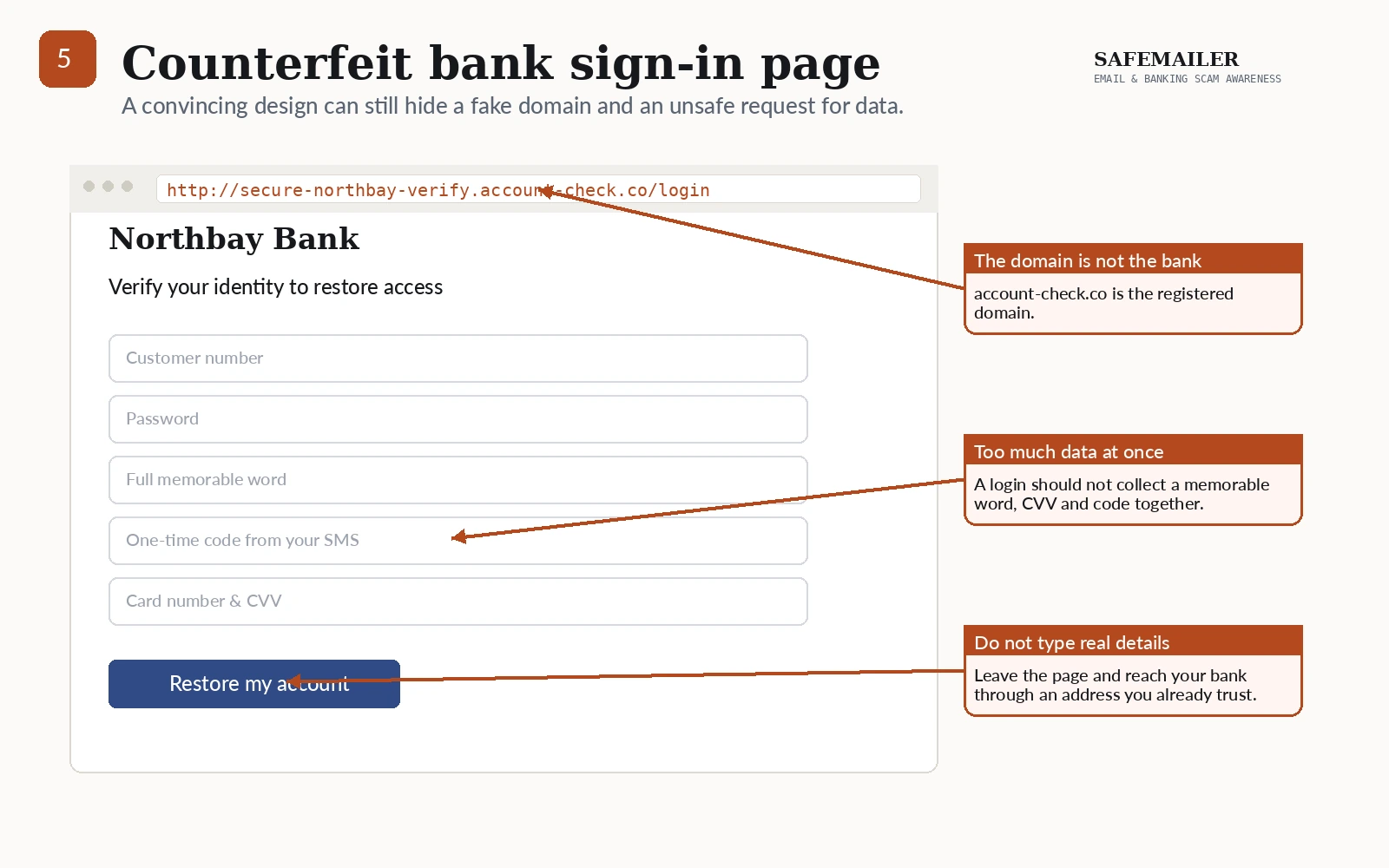
A counterfeit bank sign-in page

http://secure-northbay-verify.account-check.co/login
Northbay Bank
Verify your identity to restore access
Customer number
Password
Full memorable word
One-time code from your SMS
Card number & CVV
Restore my account
Your session will expire in 04:58. Do not close this window.
Annotated counterfeit bank sign-in page

Five tells on this page

{{ t.n }}
{{ t.head }}
{{ t.body }}
Rule of thumb: a genuine bank sign-in never asks for your full memorable word, your card CVV, and a one-time code on the same screen.

Banking fraud patterns that begin in the inbox

Same goal, different pretext. Recognise the shape and the wording stops mattering.

{{ b.tag }}

{{ b.title }}

{{ b.body }}

Tell: {{ b.tell }}

Email basics

How email services work, in plain language

Background explainers, written so the scam pages elsewhere on this site make sense. General education — not instructions for any one provider, and not personal advice.

{{ g.num }}

{{ g.title }}

{{ g.intro }}

{{ s.text }}

{{ g.note }}

Blog

Awareness notes, published weekly

Case studies on email scams, banking fraud and account security, written by our editors.

{{ c.label }}
×20 prompts
support@mail.northbay-verify.co
Your code: 482 913
Never share this code
Verification eligible
98%
mailbox full
{{ p.category }}

{{ p.title }}

{{ p.excerpt }}

{{ p.meta }}
← All articles
{{ post.category }}

{{ post.title }}

{{ post.meta }}

×20 approval prompts overnight
Inbox
support@mail-secure.
northbay-verify.co
Your verification code: 482 913
Do not share this code with anyone
Verification eligible
Creator Programme
98% full
verify within 24 hours

{{ post.lede }}

{{ sec.head }}

{{ para.text }}

Reminder

SafeMailer publishes awareness material only. We are not a helpdesk, we cannot access anyone's account, and nobody from SafeMailer will ever contact you about your email or bank.

{{ legal.kicker }}

{{ legal.title }}

{{ legal.updated }}

{{ sec.head }}

{{ para.text }}

Social login awareness · updated September 2026

Facebook and Instagram login scams — and how to protect yourself

Social accounts are stolen for the same reason inboxes are: they carry trust. A message from a hijacked profile is read, believed and acted on by hundreds of people who know the owner. Both examples below are fictional reconstructions built for teaching.

{{ s.tag }}

{{ s.title }}

{{ s.url }}
{{ s.brand }}
{{ s.pageHeading }}
{{ s.pageBody }}
{{ f.label }}
{{ s.button }}
{{ s.pressure }}
{{ s.title }}

How the approach arrives

{{ s.hook }}

What gives it away

{{ t.n }}
{{ t.head }}
{{ t.body }}
The safe habit: {{ s.instead }}

How to protect yourself

Six habits, in rough order of how much they buy you. General educational guidance — check your own provider's official help pages for the exact settings.

{{ p.n }}

{{ p.title }}

{{ p.body }}

If a social account is already taken over

Educational information only. Recover through the platform's own official account-recovery page, reached by typing the address yourself.

{{ c.n }}

{{ c.title }}

{{ c.body }}